
Ecommerce website design that actually takes the money.
Plenty of stores look the part and still lose the sale at checkout. Good ecommerce website design South Africa buyers actually complete comes down to the last thirty seconds: a gateway that works on a local card, delivery rates that are right for the address, and a checkout that does not ask for anything it does not need.
Store constructionCheckout to courier, wired
What ecommerce website design actually has to get right
A store is not a brochure site with a buy button. Six things decide whether ecommerce website design makes you money, and only one of them is how it looks.
Product pages that rank
Product schema, unique descriptions and clean category structure, so your products show up in search with price and stock rather than sitting invisible.
A checkout people finish
No forced account creation, no eight-step form, no surprise delivery cost on the last page. Most abandoned carts in South Africa are lost here.
Local payment methods
Card, instant EFT and the wallets South Africans actually use. An overseas-only gateway quietly kills a large share of your orders.
Delivery that calculates properly
Courier rates by area, free delivery thresholds, collection options and tracking, configured against the WooCommerce shipping rules. Getting this wrong loses money on every single order.
Stock that stays honest
Live stock counts, low stock alerts and variations that behave. Selling something you do not have costs you the customer permanently.
Abandoned cart recovery
Most people who reach checkout do not buy on the first visit. An automatic reminder brings a meaningful share of them back.
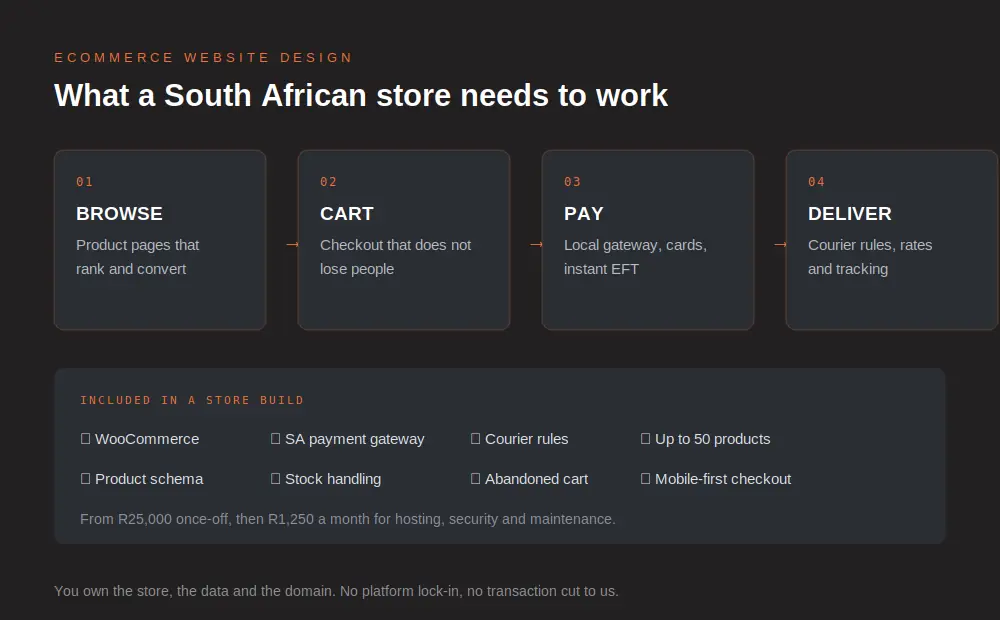
The four stages every online store build has to handle properly.
Payment gateways for South African online stores
This is the question every store owner asks and almost no agency answers properly. All of these work with WooCommerce and all of them are legitimate. The right one depends on your order values, your volume and how quickly you need the money in the bank.
| Gateway | Suits | Strengths | Watch for |
|---|---|---|---|
| PayFast | Most small and medium stores | Widest local coverage, card and instant EFT, well supported in WooCommerce, easy to set up | Per-transaction fee on every sale, settlement is not instant |
| Yoco | Businesses already taking card in person | One account across your card machine and your store, quick onboarding, clear dashboard | Best value when you are already a Yoco merchant |
| Ozow | Higher value orders | Instant EFT direct from the customer bank account, typically cheaper than card on large baskets | Bank transfer only, so customers who prefer cards need a second option |
| Peach Payments | Growing stores and multi-country | Broad payment method support, strong for scaling and cross-border selling | More setup than the simpler options, better suited above a certain volume |
| PayGate | Established and enterprise merchants | Long track record, works well with bank acquiring relationships | Heavier onboarding, generally overkill for a first store |
Fees change, so confirm current rates directly with the provider before you commit. As a rule of thumb, South African gateways sit in the low single digit percentages per transaction, and instant EFT is usually cheaper than card on larger baskets. Most stores we build run two gateways side by side, so nobody is turned away at the last step.
Whichever you choose, the product data itself has to be readable by search engines. Google publishes exactly what it expects in its product structured data documentation, and every store we build follows it so prices and stock can appear in results.
What an online store costs to run every month
The ecommerce website design quote is the easy part. This is the ongoing cost most people only discover after launch. Move the sliders to your own numbers.
per month, or 4.6% of turnover
Gateway fees are paid to the payment provider, not to us. We take no cut of your sales, ever. Confirm exact rates with your chosen gateway.
WooCommerce, Shopify or Wix for online store design
We build on WooCommerce, and we will tell you plainly when one of the others suits you better. All three sell products. They differ on what happens when you want to leave.
| What matters | WooCommerce | Shopify | Wix |
|---|---|---|---|
| You own the store and the data | Yes | Rented | Rented |
| Monthly platform fee | None | From about $39 | Tiered plan |
| Transaction cut to the platform | None | Unless you use their payments | Depends on plan |
| Fastest to launch | Middle | Fastest | Fastest |
| Local SA gateways supported | All of them | Most | Fewer |
| Freedom to customise | Unlimited | Within their system | Limited |
| Content and SEO control | Full | Good | Limited |
| Can move it elsewhere later | Yes | Painful | Very hard |
If you want a store live this week with no technical involvement at all, Shopify is a reasonable answer and we will say so. If you want to own the asset, control the search side and stop paying a platform fee forever, WooCommerce wins, which is why our ecommerce website design work is built on it.
What ecommerce website design costs in South Africa
Ecommerce website design South Africa wide is quoted here as a fixed price, in writing, before anything starts. The variable is almost always how many products need loading and how complicated the delivery rules are.
Starter store
Up to 50 products loaded, one payment gateway, courier rules, product schema, mobile-first checkout and stock handling. Live in three to five weeks.
Growth store
Everything in Starter plus a second gateway, abandoned cart recovery, product filtering, customer accounts and a blog built for search.
Store rebuild
Migrating an existing store onto WooCommerce, with products, customers and order history carried over and a full redirect map so rankings survive.
Extra product loading is R3,500 per 50 products. Every store adds a care plan from R1,250 a month for hosting, security and backups, which is not optional on a site that takes payments. Full pricing on website design packages, and the development side on WordPress developer.
Ecommerce website design questions
How much does ecommerce website design cost in South Africa?
Our starter store is R25,000 for up to 50 products, a growth store from R38,000, and a rebuild of an existing store from R28,000. Every store adds R1,250 a month for hosting, security and maintenance. Across the market you will see anything from R12,000 for a basic store to well over R100,000 for a large catalogue with custom integrations.
Which payment gateway is best for a South African store?
PayFast suits most small and medium stores because it covers card and instant EFT and integrates cleanly. Yoco makes sense if you already take card in person. Ozow is often cheaper on higher value baskets since it is bank transfer rather than card. Most stores we build run two side by side so nobody is turned away at checkout.
Should I use WooCommerce or Shopify?
WooCommerce if you want to own the store, avoid a monthly platform fee and keep full control of the search side. Shopify if you want to be live this week with no technical involvement and are comfortable renting the platform. We build on WooCommerce, and we will tell you honestly when Shopify is the better fit for your situation.
How long does an online store take to build?
Three to five weeks for a starter store, longer for larger catalogues. The build itself is rarely the delay. Waiting for product photos, descriptions, prices and delivery rules is what stretches timelines, so we send you a single spreadsheet to fill in at the start.
Can you move my existing store to WooCommerce?
Yes. Products, customers, order history and content come across, and every old URL gets a redirect so your existing rankings survive the move. Migrations from Shopify, Wix, Magento or an older WooCommerce install are all routine.
Do you take a percentage of my sales?
No, and we never will. You pay the build price and the monthly care plan. Gateway fees go to your payment provider directly. Any agency taking a cut of your turnover has an incentive that is not aligned with yours.
Will my products show up on Google with prices?
That is what product structured data is for, and it goes on every store we build. It lets Google display price, availability and reviews directly in results. It is not a guarantee of placement, but a store without it cannot appear that way at all.
Which payment gateway should I use in South Africa?
It depends on your volumes and customers. PayFast has the widest reach, Yoco suits businesses already using their card machines, Ozow is strong for instant EFT, and Peach and PayGate suit higher volumes. We set up whichever fits and never take commission on your sales.
Do you charge commission on my sales?
Never. You pay for the build and the care plan, and every rand your store takes is yours minus your gateway fees. Platforms that take a percentage of revenue get expensive precisely when you start succeeding.
Can you load my products for me?
Yes, at R3,500 per fifty products including images, descriptions, variants and categories. If you have a supplier spreadsheet we can often import in bulk for less, so send it over before assuming the manual price.
How do I handle deliveries and courier costs?
We set up shipping rules by weight, cart value or region so the customer sees a real price at checkout. Integrations with the common South African couriers are available for automatic rates and tracking.
Is WooCommerce better than Shopify for South Africa?
For most local businesses, yes, mainly because there is no monthly platform fee and no revenue commission, and local gateway support is excellent. Shopify is simpler if you want everything managed and do not mind paying monthly for it. The comparison table above sets out both fairly.
Can my store handle stock across a physical shop too?
Yes, with a point of sale integration so stock reduces in both places from one source. Worth setting up from the start, because reconciling two separate stock systems later is painful.
What about VAT and invoicing?
VAT is configured correctly for South African rates, tax invoices are issued automatically on purchase, and the store can push orders into Xero or Sage so your accounts stay current without manual capture.
The rest of what we build
An online store is one part of it. Everything below is built by the same people, on the same stack, and quoted the same way. Start from website design company in South Africa for the overview.
Tell us what you sell. Get a store quote in 24 hours.
Send us your product range, roughly how many items, and where you deliver. Ecommerce website design starts with knowing what is actually being sold. We will come back with a fixed price, a realistic timeline and which payment gateway we would put you on.