
Website performance decides who waits and who leaves.
Most South African visitors arrive on a mid-range phone, often on data, sometimes on a weak signal. A site that takes six seconds loses a large share of them before it renders, and Google measures the same delay through Core Web Vitals. Website performance work fixes both problems with one set of changes, measured before and after rather than asserted.
Website performance from R4,500 once-off, or R3,450 a month ongoing, with before and after numbers you can re-run yourself.
Vitals greenMeasured on real visitors, not lab tests
What website performance work actually fixes
Nine causes, in roughly the order they matter on a typical South African business site. We work down this list by what each one costs you in milliseconds, not by what is easiest.
Oversized images
The single biggest cause, every time. A 4MB photo straight off a phone displayed at 600 pixels wide. Converted to WebP, resized properly and lazy loaded, frequently cutting page weight by eighty percent.
Render blocking scripts
Fonts, trackers and plugin code that must download before anything appears. Deferred, inlined or removed so the page paints while the rest loads behind it.
Slow server response
Time to first byte over 600ms means the visitor waits before a single pixel exists. Usually cheap hosting or an unoptimised database, and both are fixable.
No caching or CDN
Pages rebuilt from the database on every visit instead of served ready-made from an edge location near the visitor. Correct caching is often the largest single improvement after images.
Plugin bloat
Every plugin adds code to every page, including pages that never use it. Auditing what is genuinely needed and removing the rest routinely takes seconds off load time.
Layout shift
Content jumping while images load, making people tap the wrong thing. Fixed by reserving space, and it is one of the three metrics Google grades you on directly.
Database bloat
Years of post revisions, expired transients and orphaned tables from removed plugins making every query slower. Cleaned and indexed properly rather than with a one-click plugin.
Font loading
Custom fonts that block text from appearing, or cause a visible flash when they swap in. Preloaded and configured so text is readable immediately.
Third party scripts
Chat widgets, pixels, heat maps and analytics, each adding weight. Loaded late and only where they earn their place, so they never delay the page itself.
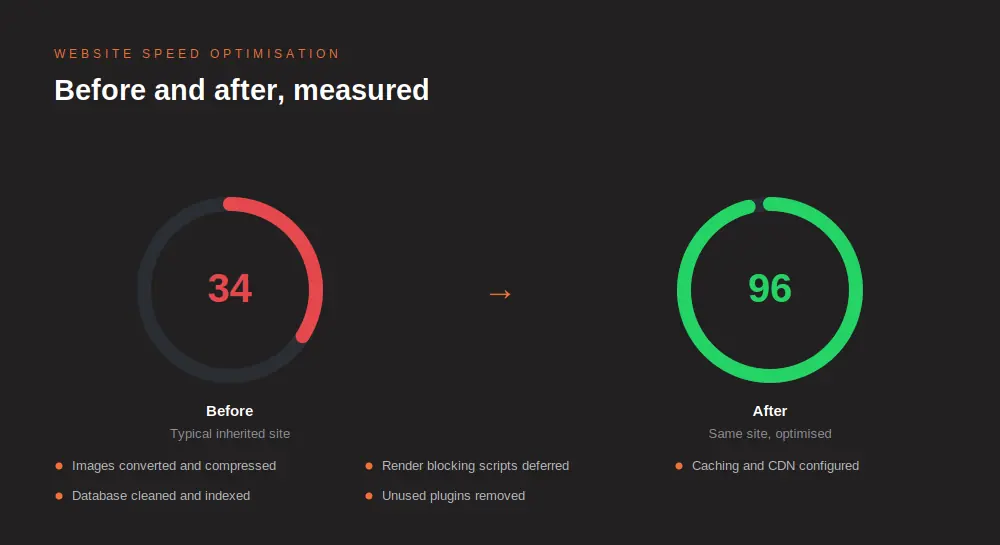
Same site, same content. The difference is configuration, not a rebuild.
Core Web Vitals, in plain language
Google grades every site on three measurements taken from real visitors, published openly as Core Web Vitals. Here is what each one actually means, without the acronym soup.
| Metric | What it measures | Pass | Fail |
|---|---|---|---|
| LCP | How long until the main content appears | Under 2.5s | Over 4s |
| INP | How quickly the page responds when tapped | Under 200ms | Over 500ms |
| CLS | How much the layout jumps while loading | Under 0.1 | Over 0.25 |
| TTFB | How fast your server starts responding | Under 600ms | Over 1.8s |
Why website performance is worth paying for
- It is a ranking factor. Not the biggest one, but when two sites are otherwise close the faster one wins, and that describes most competitive local searches.
- It decides who stays. Every additional second costs conversions, and the effect is sharpest on mobile, which is where most of your traffic is.
- It lowers your ad costs. Google scores landing page experience when setting cost per click, so a faster page pays less for the same position.
- Data costs money here. A page that is 4MB instead of 600KB is asking a South African visitor to spend their own airtime to see it, and plenty of them will not.
- It compounds with SEO. A faster site gets crawled more thoroughly, so new pages get indexed sooner and the whole SEO programme moves quicker.
Your PageSpeed score is not what Google uses
This is the most common misunderstanding in website performance, and a lot of money gets spent chasing the wrong number because of it.
The score out of 100
A simulation. One run, on a simulated device, on a simulated connection, from wherever the test server happens to be. It moves several points between runs on the same site with nothing changed. It is useful for diagnosis and almost useless as a target.
What Google actually scores you on
Real measurements from real visitors on real phones over twenty-eight days, reported in Search Console. This is what feeds ranking. A site can score 55 in the lab and pass Core Web Vitals comfortably in the field, and the reverse happens too.
We work from your field data and use the lab score only to find causes. If somebody has quoted you to "get your score to 90", ask which of the two they mean, because the answer tells you a great deal about the quote.
How website performance work is done
Measure, fix the biggest cause, measure again. Never guess, and never change five things at once without knowing which one worked.
Baseline measured
Real user data from Search Console plus lab tests, on mobile and desktop, so we know what visitors actually experience rather than what we assume.
Causes ranked
Every issue listed by how many milliseconds it costs, so work starts where the return is largest rather than where it is easiest to bill.
Fixed on staging
Changes applied to a copy first and checked page by page, because aggressive optimisation genuinely can break layouts if nobody looks.
Verified and shipped
Re-measured on staging, then pushed live. You get before and after numbers rather than an assurance that it feels faster.
Monitored ongoing
Website performance decays as content and plugins accumulate. Monthly checks catch the drift before it costs you rankings.
We do website performance work for businesses across Johannesburg, Sandton, Midrand, Centurion, Pretoria, Cape Town, Durban, Gqeberha, Bloemfontein and Polokwane, and remotely nationwide. Hosting sets the ceiling on all of it, which is covered on managed hosting.
Website performance pricing
Website performance work is once-off if the site just needs fixing, ongoing if you want it to stay fixed. Most sites need both, in that order.
Speed optimisation
A full pass over an existing site: images, caching, scripts, database and fonts, with before and after numbers.
- Baseline and cause analysis
- All nine fix areas addressed
- Tested on staging first
- Written before and after report
Growth plan
Ongoing monitoring with quarterly tuning, so website performance does not quietly decay as the site grows.
- Core Web Vitals monitored
- Quarterly optimisation pass
- New images optimised on upload
- Monthly performance reporting
Critical plan
For stores and high-traffic sites where speed maps directly to revenue and slowdowns need catching within the hour.
- Continuous monitoring
- Monthly optimisation passes
- Load testing before campaigns
- One hour response commitment
Plan comparison on website maintenance packages. If the site is fundamentally too heavy to rescue, a website redesign is often cheaper than optimising it forever, and we will say so rather than sell you passes that cannot work.
Website performance questions we get asked
What does website speed optimisation cost in South Africa?
A once-off website performance pass is R4,500 with us, and ongoing monitoring sits inside the R3,450 a month plan. Locally you will see R1,500 for somebody installing a caching plugin, and R15,000 upward from larger agencies. The difference is whether anyone measures before and after, and whether the work touches images at all.
My PageSpeed score is 40. Is that bad?
Worth investigating, and do not obsess over the number. The lab score is a simulation that moves several points between runs with nothing changed. What Google actually uses is field data from your real visitors, reported in Search Console. We work from that and use the lab score only for diagnosis.
How much faster will my site actually get?
On a typical unoptimised WordPress site, load times commonly drop by half or more and mobile scores often move from failing to passing. We measure your baseline first and tell you what is realistically achievable rather than promising a number blind.
Is a caching plugin enough on its own?
It helps, and it is roughly a third of website performance work. Caching does nothing about 4MB images, render blocking scripts or a bloated database. Installing one and calling the job done is exactly why plenty of sites are still slow despite having a speed plugin.
Do Core Web Vitals really affect rankings?
Yes, though they are a tiebreaker rather than the main event. Content and relevance matter more. But most local searches are decided between sites that are otherwise very similar, and that is exactly where a tiebreaker decides the outcome.
Will optimisation break my website?
Not the way we do it, because everything is applied to a staging copy and checked page by page before going live. Aggressive optimisation genuinely can break layouts, which is precisely why it is not a one-click job and why we do not sell it as one.
Why did my site get slower over time?
Website performance decays as content and plugins accumulate. Every new image, tracking script and plugin adds weight, and nobody notices month to month. That gradual drift is the reason performance belongs on a monthly plan rather than being a once-off purchase you repeat every three years.
Does hosting affect website performance?
Substantially. Hosting sets the ceiling, because server response time is where the page begins, and cheap shared hosting often costs a full second before anything else has started. Optimising a site on poor hosting has a hard limit you cannot code your way past.
What about images I upload myself later?
On a plan, new uploads are converted and compressed automatically, so your team can upload straight from a phone without slowly ruining the site. That single automation prevents most of the decay we see on client sites.
Does speed matter more on mobile?
Considerably, and mobile is where most South African traffic is, so website performance is judged there first. Mobile devices are slower to process pages, connections vary, and data costs the visitor real money. Everything is optimised mobile first for that reason.
Can an e-commerce store be fast?
Yes, though it needs more care because carts and checkouts must never be cached. Done properly a WooCommerce store passes Core Web Vitals comfortably, and on a store the conversion effect of speed is directly measurable in sales rather than inferred.
How long does the optimisation take?
About a week for a standard site: measured, fixed on staging, verified and launched. Larger sites and stores take two, mostly because there is more to check page by page before pushing live.
The rest of what we do
Website performance is one part of what we do. Start from website design company in South Africa for the overview.
Find out what your visitors are actually waiting for.
Send us your web address and we will send back a free website performance report: your Core Web Vitals on mobile and desktop, the biggest causes ranked by what they cost you in milliseconds, and what is realistically achievable.